
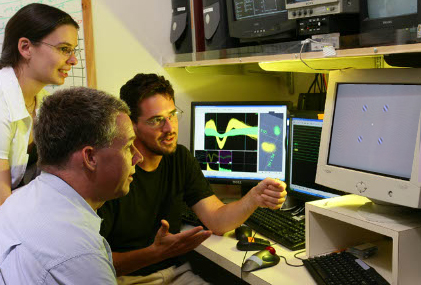

Jude Mitchell
- For further details and project updates, please contact Jude at jude@salk.edu.
- Recent Theoretical Work:
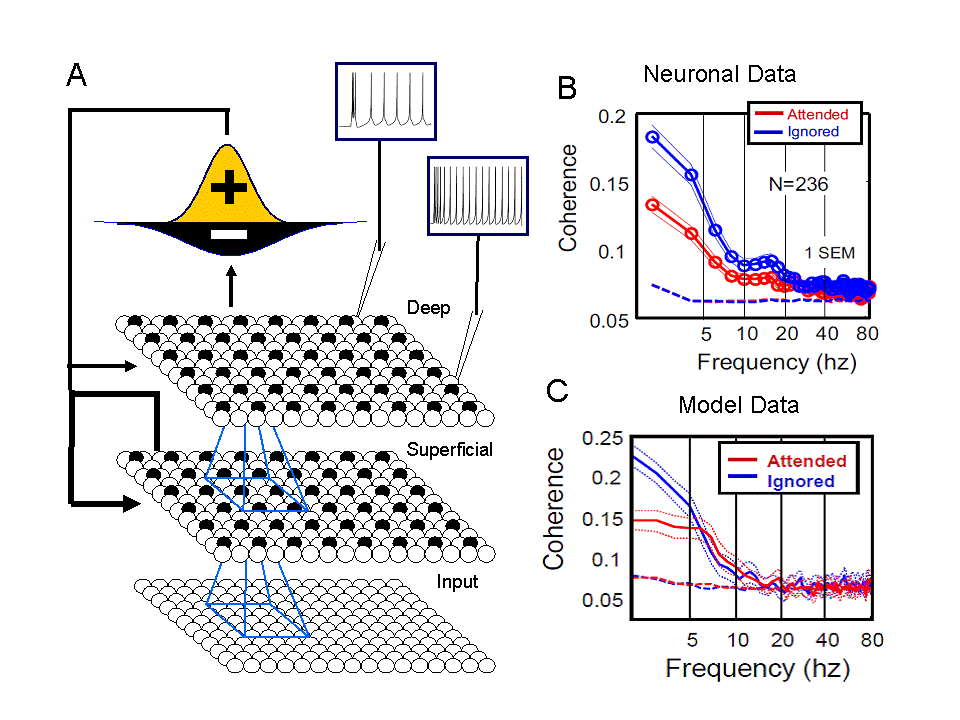
- Gordon Research Conference Talk July 11,2013 (Slide Presentation) and two demos from talk:
- Research Areas & Aims:
- How spatial attention alters statistics of neuronal spiking
- Extracellular classification of neuronal types in awake animals
- Systems identification models of sensory processing and attention
- Network models of spiking neurons and correlations in firing
- Human psychophysics in object-based attention, recognition, and perceptual learning
- Recent Posters:
- COSYNE 2012 Curvature tuning in V4
- SFN 2011 Reductions in burst firing and waveform adaptation
- Swartz Annual Meeting 2011: Extended Normalization Model of Attention
- SFN 2010: Neuronal reponses to occluded items during tracking
- VSS 2009 Slide Presentation (large file, in pdf format)
- Cosyne 2008 Burst spiking and power spectra modulation
- Select Publications:
- The fine structure of shape tuning in area V4. AS Nandy, TO Sharpee, JH Reynolds, JF Mitchell. Neuron, 2013, 78:1102-15.
- Attention-dependent reductions in burstiness and action-potential height in macaque area V4. EB Anderson, JF Mitchell, JH Reynolds. Nat Neurosci, 2013, in press.
- Attention influences single unit and local field potential response latencies in visual cortical area V4. KA Sundberg, JF Mitchell, TJ Gawne, JH Reynolds. J Neurosci, 2012, 32(45):16040-50.
- Attentional modulation of firing rate varies with burstiness across putative pyramidal neurons in macaque visual area V4. EB Anderson, JF Mitchell, JH Reynolds. J Neurosci, 2011, 31(30):10983-92.
- Spatial attention decorrelates intrinsic activity fluctuations in macaque area V4. JF Mitchell, KA Sundberg, JH Reynolds. Neuron, 2009, 63. 879-888. .... and Supplemental
- Spatial attention modulates center-surround interactions in macaque visual area V4. KA Sundberg, JF Mitchell, JH Reynolds. Neuron, 2009, 61. 1-12.
- Differential attention-dependent response modulation across cell classes in macaque visual area V4. JF Mitchell, KA Sundberg, JH Reynolds. Neuron, 2007, 55. 131-141. ... and Supplemental
- ERP evidence that surface-based attention biases interocular competition during rivalry. W Khoe, JF Mitchell, JH Reynolds, SA Hillyard. J. Vision, 2008, 8(3):18, p1-11.
- Exogenous attentional selection of transparent superimposed surfaces modulates early event-related potentials. W Khoe, JF Mitchell, JH Reynolds, SA Hillyard. Vision Research, 2005, 45. 3004-3014. [pdf]
- Object-based attention determines dominance in binocular rivalry. JF Mitchell, GR Stoner, JH Reynolds. Nature, 2004, 429. 410-413. [pdf]
- Sequential memory-guided saccades and target selection: A neural model of the frontal eye fields. JF Mitchell and D Zipser. Vision Research, 2003, 43. 2669-2695. [pdf]
- Attentional selection of superimposed surfaces cannot be explained by modulation of the gain of color channels. JF Mitchell, GR Stoner, M Fallah, and JH Reynolds. Vision Research, 2003, 43(12). 1323-8. [pdf]
- A model of visual-spatial memory across saccades. JF Mitchell and D Zipser. Vision Research 41(2001): 1575-1592. [pdf]
- Age-independent stability, prevision, and near-24-hour period of the human circadian pacemaker. Czeisler CA, Duffy JF, Shanahan TL, Brown EN, Mitchell JF, Rimmer DW, Ronda JM, Silva EJ, Allan JS, Emens JS, Dijk DJ, Kronauer RE. Science, 1999, June, 284: 1-5. [pdf]
- Sample code and links
- Spike-Spike Coherence (Matlab code and sample pair of neurons from 2009 paper)
- Sample Matlab Code with V4 Data (Fano Factor, Power Spectra, and Coherence Analyses)
- Link to Thomas Kreuz's website with related ISI-distance analysis
- Matlab Code for Spike Classification:
- Spike Waveform Classification: ZipFile or Source
- Maximum Likelihood ISI Distribution Fitting (Single and Dual 'Burst' Process Fits): ZipFile or Source
- Attention Task Demo:
- Multiple-Object Tracking in a Macaque:
This video shows the attention-demanding video game that the monkeys
performed. The monkeys fixated the white dot at the center of the computer monitor,
and four striped stimuli like those in this demonstration, appeared. Their eye
position was carefully monitored using a camera. The red cross shows where the eyes
were pointing throughout each round of the game. The circle shows the location of
the receptive field of the neuron under study on the day that this demonstration was
recorded. At the beginning of each round of the game, either one or two of the stimuli were
highlighted, indicating to the monkey that they were the targets of attention. The
stimuli then moved to new locations and paused, with one stimulus in the receptive
field. After a brief pause, they moved to new locations and the fixation point
disappeared. The monkey was rewarded with juice if it then looked at the cued
targets, proving that they had been tracked. In the latter part of the
demonstration, we illustrate neuronal responses from individual rounds of the game.
Tick marks indicate when the neuron emitted individual action potentials when the
stimulus in the receptive field was tracked (red tick marks) or ignored (blue
tick marks).
- Attention Dask Demo (Avi File)
- 2nd Demo (run at half-speed)
- Matlab code to make and show movies
- Course Information:
- Introduction to Probability and Statistics. Summer Course, UCSD, 2000
- Other Resources & Matlab Code:
- Sample Spike-LFP Coherence Data (3 narrow spiking units): ZipFile or Source
- Saccade Detection Algorithm for I-Scan Eye Position Signals:
- Algorithm fits the position traces at each time with a parametric sigmoid step function and its derivatives (modeling a discontinuity) or a smooth spline with equal number of free parameters. If the sigmoid fit is 30% better it is considered to be a saccade, as long as the event passes a velocity and acceleration threshold (10deg/s and 100 degs/s^2). Note updated file (1/4/2012, "detect_iscan_saccades2.m" will throw out cases of the same saccade identified twice by the algorithm, if more than 25% temporal overlap). Download all files, run "sacanalysis" in Matlab
- Spike Waveform Classification: ZipFile or Source
- ISI Distribution Fitting (Single and Dual 'Burst' Process Fits): ZipFile or Source
- A Neural Model of the Frontal Eye Fields: Source
- Training Protocol for Rat, version 1.0 (requires psych-toolbox): ZipFile (Matlab code, Run 'ratplay')
- Algorithm fits the position traces at each time with a parametric sigmoid step function and its derivatives (modeling a discontinuity) or a smooth spline with equal number of free parameters. If the sigmoid fit is 30% better it is considered to be a saccade, as long as the event passes a velocity and acceleration threshold (10deg/s and 100 degs/s^2). Note updated file (1/4/2012, "detect_iscan_saccades2.m" will throw out cases of the same saccade identified twice by the algorithm, if more than 25% temporal overlap). Download all files, run "sacanalysis" in Matlab
- Neuron and Matlab Code (Older version of code, Summer 2008)
- Older Posters at Conferences:
- Attention-dependent reductions in response variability in area V4 associated with changes in spike power spectra and burstiness. JF Mitchell, KA Sundberg, and JH Reynolds COSYNE. 2008 [pdf]
- Sparse reverse correlation sequences improve estimation of V4 neuronal tuning functions. JF Mitchell and JH Reynolds Soc. Neurosci. 2006 [pdf]
- Attentive tracking of multiple objects modulates neuronal responses in area V4 of macaque. JF Mitchell, KA Sundberg, and JH Reynolds Vision Sci. Soc. 2006 [pdf]
- Attentive tracking of multiple objects by humans and monkeys. JF Mitchell, KA Sundberg, and JH Reynolds Vision Sci. Soc. 2005 [pdf]
- Comparison of Human and Macaque Ability to Attentive Track Multiple Visual Stimuli. JF Mitchell, KA Sundberg, and JH Reynolds Soc. Neurosci. 2004 [pdf]
- Both Motion and Texture Cues Contribute to Object-Based Selection in Binocular Rivalry. JH Reynolds, GR Stoner, and JF Mitchell Soc. Neurosci. 2004 [pdf]
- Recent Theoretical Work: